
The Anti-Loneliness App We Need
But we’ll never get.

Background
During Covid, around 2021, I was thinking of new careers and like the rest of us, completely isolated from friends and other people. I’d noticed this feeling of isolation was not new, that it was just a more extreme example of a process that was already running and I wondered about making an app to address it.
I thought about it deeply. This wasn’t particularly because of less opportunities to meet people. I always spend most of my day outside in places where there are a lot of people. There are also more people in the world in general than 10 or 20 years ago. No, the difference I realized was that people were different. Or more specifically, the way they act is different.
I’d gone through all the generations of social media and dating apps, and the Meetup app, and found that they too were successively worse. More restrictions on direct messages, more algorithmic silos, more ad content, more emphasis on photos and less on personalities. No NetFlix shared passwords, subscriptions to everything. And around 2021 the AirPods and bluetooth headphones in general started to really proliferate. FaceTime in public where people are walking like zombies in their bubble talking about KPIs loudly.
Essentially, I noticed the walls around people in public and private were now impenetrable. You have to shout at someone with AirPods on in order to bring their attention to a dropped scarf. We reached a point around 2021 where it was now impossible to start both online and organic real-life interactions.
Pay a subscription to live is basically the world we have arrived at. That’s when I realized this idea of an “anti-loneliness app”.
A True Social App
Today’s social apps are really anti-social apps. They encourage people to remain separate by giving them just enough dopamine to activate their pleasure centres without ever having to meet in real life. Then they sell you access to a small range of people who you can afford and they decide who will be in your pool. It appears increasingly this pool is specifically chosen to reduce the likelihood of you meeting anyone. They push your buttons to make you angry enough to interact with the platform, often with fake users. Just enough to keep you hooked. Maybe throw in a mindless game to command the last minutes of attention when you might otherwise leave the main part of the app. Total immersion.
By that logic, social apps that successfully get you interacting in real life are antithesis to companies’ apps continued existence. You don’t need them after you start making friends and doing things. But that’s exactly what we all want and need. And that’s why I came up with my vision of what I call Hangouts.
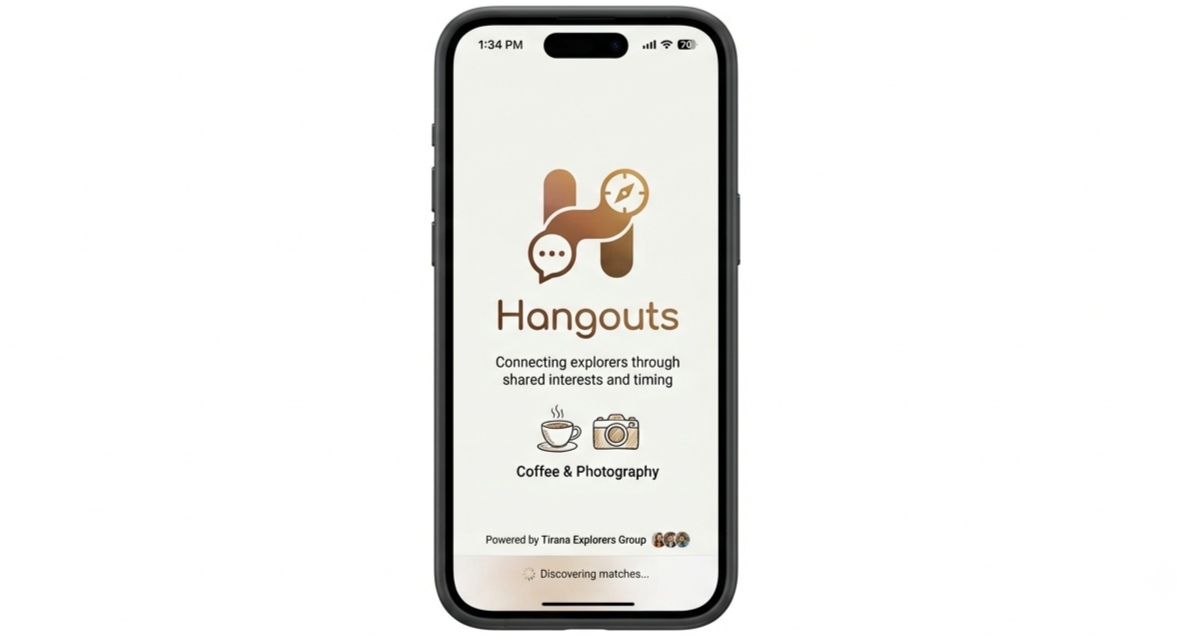
Google’s 15 second screenshot generation of my Hangouts description.
Yes, I know Hangouts has been used by other companies. Just bear with me on this thought exercise—I’m not making the app.
I’m making the point because the word “Hangout” is what encapsulates the kind of interactions people in 2026 most want and need. Low-pressure, time and location-aligned, interest-aligned interactions. You know, the kind we would have randomly in the supermarket, around the water cooler at work, or on the subway pre 2020. Back when we paid attention to someone’s outfit, accoutrements or the topic of the book they were reading and then made a friendly comment in the hope of having some human connection.
How It Works
This app is so simple, anybody could vibe code it in a day or two and build the backend in under a month. First you choose your interests:
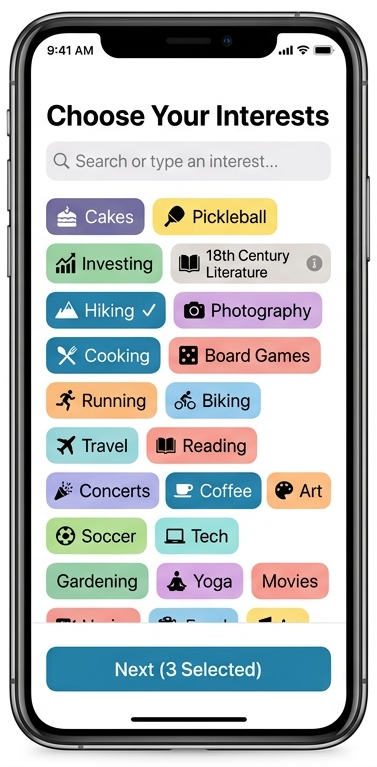
The more the merrier, there is no limit to the amount of potential matching on the app. Secondly, choose the time and format of the activity.
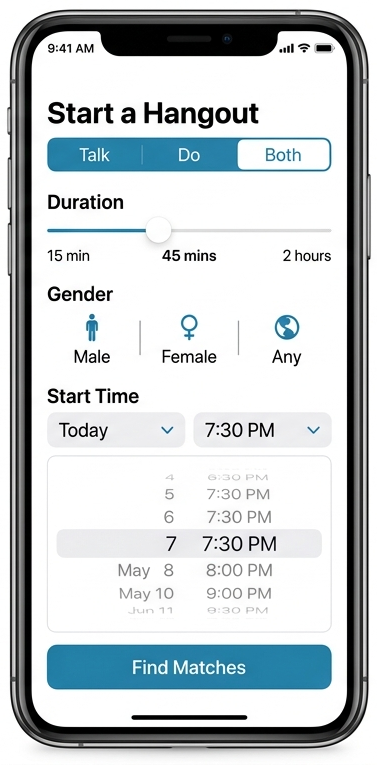
You want to make it a friend meetup? Fine. You want to search for someone of the opposite sex? Fine. You don’t care which? Fine. It doesn’t matter. The whole point is you just want to find someone to hang out with.
You're free now? Great! You’re free at 7:30PM? Great! You can only handle people for 15 minutes? Great! You want to talk to someone for 2 hours? Great! You’re free to choose the timing of when you hang out.
Do you see a pattern here? The power to decide the shape of the interaction comes from the user, not the company. Just like in real life where people decide how long they want to hang out with someone. It’s not gate-kept by your tech company chaperone. You don’t have to “unlock” the 2 hour hangout with a subscription fee. Imagine, if in real life you want to hang out longer with someone and they say “sorry, that will be a $20/month subscription to show you really like me.” Oh wait…
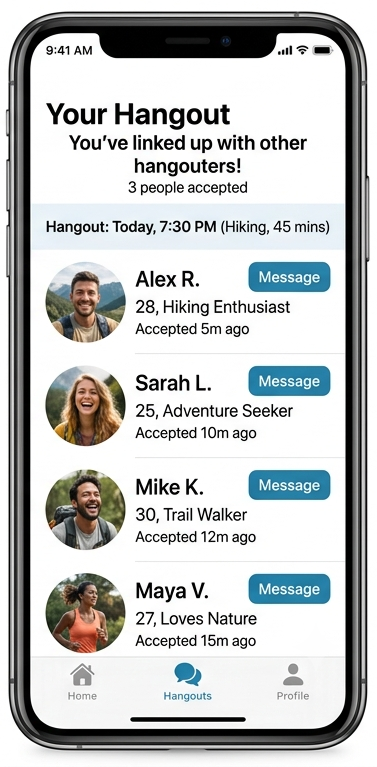
The next step is, other people who are nearby are able to see your Hangout and say they want to join you. What an idea! Then, you can message them directly to work out the details. Like in real life you are able to modify the plan somewhat and to feel out if the person is scary or not. Hey, you could even join multiple people to do the activity as a group! This is revolutionary. How did people do this before we had apps!?
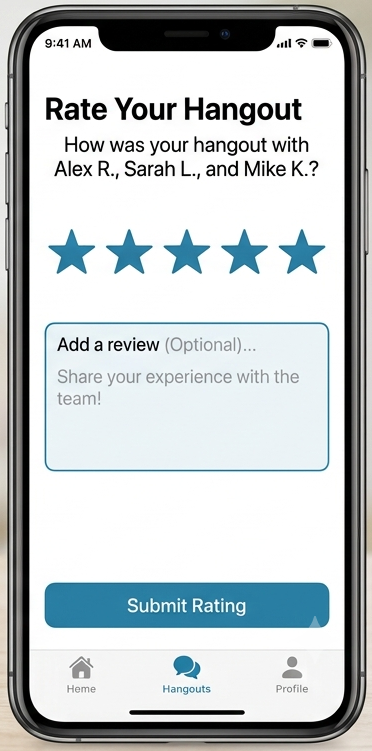
Finally, after you hang out with the person, you leave a review. Maybe these things aren’t made public, but if people know they will get a rating, then there’s a good expectation that they’ll behave themselves. You know, like in real life you’d behave yourself if you knew you were going to see the person again.
Instead of stars, we could be more magnanimous, as we’d hope people are in real life - It was OK / It was Great!. We can use some generous algorithm to ensure that only the repeated “not great” people are affected, because we want to believe that everyone does want a nice and repeatable interaction. Faith in the goodness of human spirit built in!
Recap
Are you picking up what I’m throwing down? Do you see how easy an app like this would be to facilitate meeting people literally everywhere? For example, you could be working and heading to lunch and want a 15 minute talk about stocks over lunch. Make a hangout and within seconds you can be meeting a person to do just that. No exchanging numbers, no ripping their headphones off their head on the way to the cafeteria, no long stares at the copy machine to see if they notice your existence. It’s completely opt-in mentality where everyone benefits from saying yes.
Why Don’t We Have This App?
I speak facetiously on purpose to show how utterly obvious this app is. We all intuitively know how it would work and are familiar with the general format from nearly all other apps selling products or services. But this not selling a product or service. It’s Uber to deliver people.
So why hasn’t Uber or FaceBook or any of them done it? Because it would ruin all their business models and people would be too happy, too fulfilled. It’s too simple. I want to highlight how sad a state we are in by looking at what they’d do:
The app requires a large user base to be able to be really useful and the tech companies now control the gate for promoting their would-be competition. A small developer simply cannot compete with that kind of reach in growing their user base. Even with a couple hundred thousand marketing dollars, could a small company even reach the demographic anymore? No, the tech companies would restrict their ad spend or simply make it too expensive to pull off. Instead, any of the monopoly-companies could market the hell out of it to all their existing users for free as a “new way to connect”, or spend billions on competitors platforms in promotion. Pretty hard for any new entrant to do that.
If a company did manage to get a foothold in the market and have say 100,000 or a million users, they’d sue the hell out of them to put them out of business claiming copyright etc. The legal fees would bankrupt just about anybody. All this for an app that by definition has no special features. It just allows organic reach to thrive. It reveals exactly how inorganic the reach of the tech companies really is. As they say, they fastidiously protect their “moats”. But these are moats that atomize people.
Even if they didn’t sue the company out of existence, they’d make their own app that was identical and out-compete it with their user base. There are countless examples of this from the past 10 years. As soon as they beat the smaller guy into submission they’d paywall all the various features. Monthly fees, unlocking longer hangouts, geographic fencing, unlocking more allowed interests. Sounds kind of fascist doesn’t it? “We won’t allow you to have that many interests!”
If all that failed, they’d just buy the up-and-comer app and pervert it after the fact, or shut it down as Google, Apple and the Match Group routinely do.
CONCLUSION
From the common man on the street to YouTube podcasters to scientists, we all agree we are in a loneliness epidemic. For those of us who lived pre-internet we know viscerally how things used to be, can be and should be. We’re longing for it. For the younger people, they can feel something is wrong. They’re especially anxious, scared, lonely, defensive, and hopeless because even though they didn’t experience real life before the internet, their bodies know something is wrong.
Our lives are being sold back to us piece by piece on a monthly subscription under the guise of “convenience” when really the entire economy nowadays leverages one human weakness - our propensity for quick dopamine hits.
The antidote is human connection. The big companies know this and actively discourage it. That’s why an app like Hangouts doesn’t and can’t exist. It’s not profitable for them at their scale of trillions. Even if they could make mere billions by having a reasonable subscription fee to cover the actual costs of running the app, they’d never do it. It’s just a pale fraction of the money you can make by subjugating people. In fact, they’d rather create an entirely artificial friend (in the form of AI) for each of us at the cost of trillions of dollars and sell that back to us than to allow the free resource of billions of people to simply interact directly.
All the while, they’re burning through planet-killing energy use, and if successful will probably kill all the regular jobs and silo those behind their pay-wall too. That’s why hanging out, such a simple concept is actually the single most dangerous risk to them. Dictators know this and have always used it. Keep ‘em separated, in-fighting and distract them with pomp and circumstance.
They know that the enemy is FREE dopamine. AND serotonin. AND the potential that people will get together and realize that they are being taken advantage of. Can’t have that!!
There are some glimmers of hope. In a way, people are somewhat waking up (or growing up) to the idea that their dopamine weakness equals slavery. Lately we’ve seen the rebranding of Meta’s RayBan smart glasses as “pervert glasses” in major media. I hear 30 year olds saying they’ve never used AI and I’m shocked. They say “I don’t want it.” They don’t know why they hate it, but they feel it’s wrong and I think it’s because they subconsciously know it’s out to take their future livelihood. People stopped upgrading their phones for the same reason. It’s a subscription to something that they already have, that doesn’t get better, but the paying goes on forever.
Maybe the Hangouts app can magically get made. That would be great moment for a technology focusing on empowerment. It would go a long way to reminding people that they have agency and can enjoy life through and with other real people. And after this technological half-step backwards (forwards), perhaps more of us, even all of us, can reach the final tech-free step which is as always— hanging out together.
PRICE
Developing the app
AVAILABILITY
Miracles happen
THE RATING
10/10 Absolute
10/10 Relative
Your donation helps keep the reviews coming!