
Toronto’s Insane New Bike Lanes
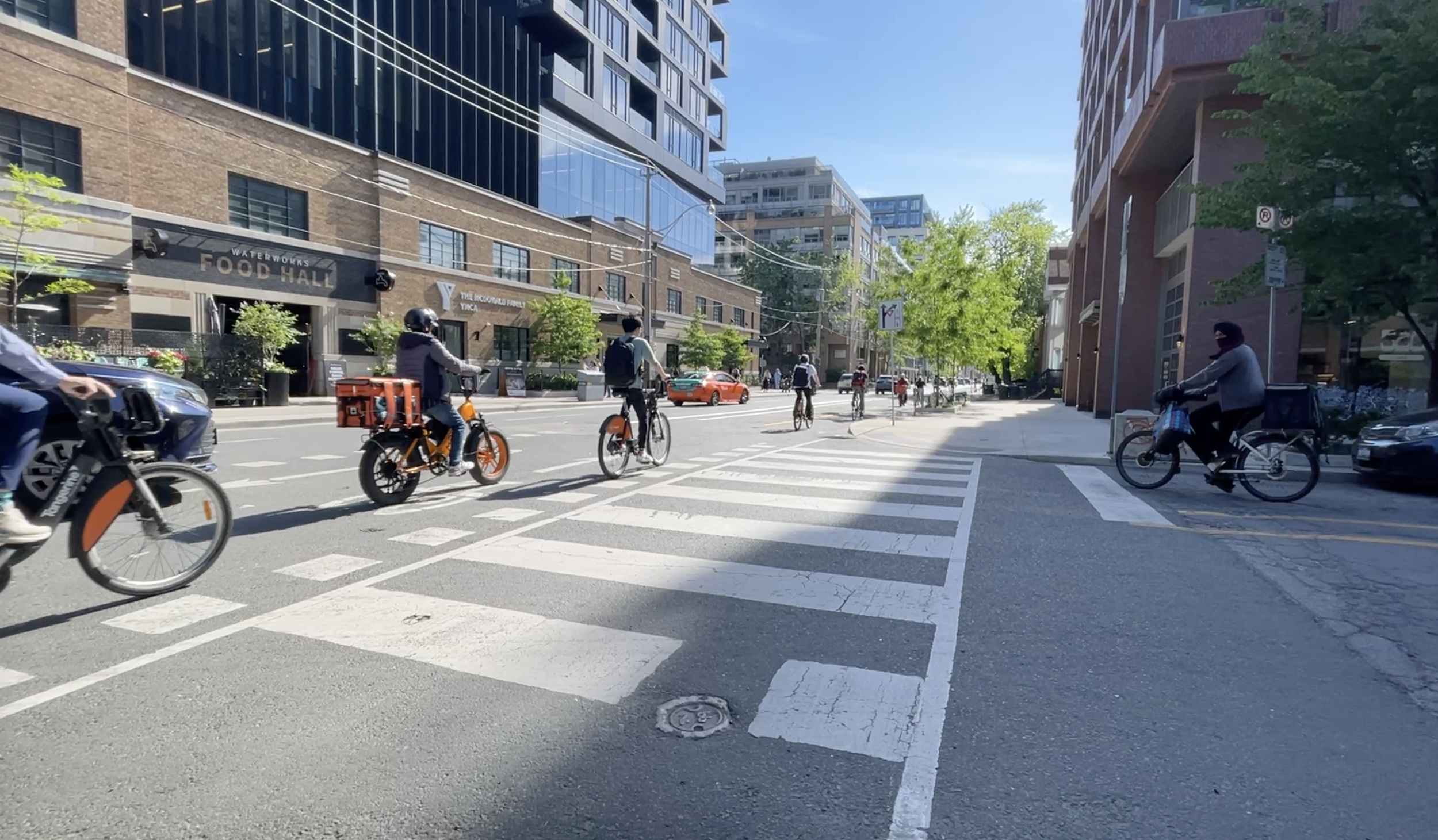
I’m going to say this up front. Two-way bike lanes on normal streets are a disaster. I will outline 3 reasons why—Safety, Ease of Use, and Space Usage.
Background
In June 2026, Toronto installed a number of new two-way bike lanes in the downtown area, specifically on Portland street, and secondarily expanded one way lanes to two-way on Richmond St. West of Spadina. This was a second phase of the original single-lane bike lanes just on Richmond and Adelaide from about 5 years prior.
By all accounts the original bike lanes worked well. There was such a rise in bike traffic that it was reported in the news. In fact, it was so notable to me that I planned to make an art video of Kraftwerk Tour de France playing while the 5pm rush came down Richmond. Not only was there a new massive quantity of riders, but the zeal and speed that many were riding at suggested that the bike lane had totally freed their minds from the restriction of worrying about cars (or pedestrians). This is an important point to circle back to later.
Fast-forward to 2026 and the aforementioned “upgrades” of the bike lanes. It has been a disaster from the first day they were installed. So bad it operates and so poorly thought out— regardless of whether you are a bike rider, pedestrian or driver— that I felt compelled to write an article pointing out why so that it can be rectified immediately.
Safety
Naturally one of the major concerns (if not the prime concern) of bike lanes is to protect cyclists from getting hit by cars. The theory makes overt sense. Give bikes their own lane, often walled off, raised, or at least using painted lines to keep the cars away. In a standard bike lane with one direction of traffic flow, this is a pretty simple and easily implementable concept.
Especially if the lanes are flowing in the same direction as the car traffic, there is no mental incongruity to navigating the road for anybody. Cars go forward, bikes go forward. You look to the lane you want to enter before changing to it, just like we’ve all been taught when driving, or intuitively will do for self-preservation and not hitting an adjacent vehicle or person. Easy.
If this is on a one-way car road, it is about as simple as you can make a bike lane and still achieve bike safety improvements. On bi-directional car roads, it’s still pretty simple because the bikes are in the gutter lanes traveling the same way the cars are so both cars and bikes have a simple logic when turning off the main road. The rule is basically, if you’re a car, check your one blind-spot before entering the lane of bikes, or if you are a bike, check right for pedestrians when turning off the street if you are a bike. Turning left also is relatively the same. All oncoming traffic is coming in the same direction toward you and you have only to look to see if something is impeding the path you want to go. Whether 2-way car road or one-way car road, bike lanes have consistent rules for everyone.
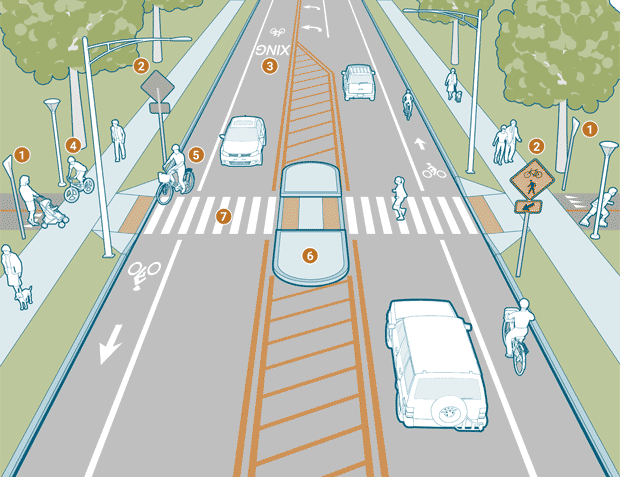
You’ll have to do some imagining with the below photo but it should’t be too hard to see that this system basically works. A one-way road version with a bike lane is just either the left or right side of the photo.
Contrast this to two-lane bike paths on a similar road:
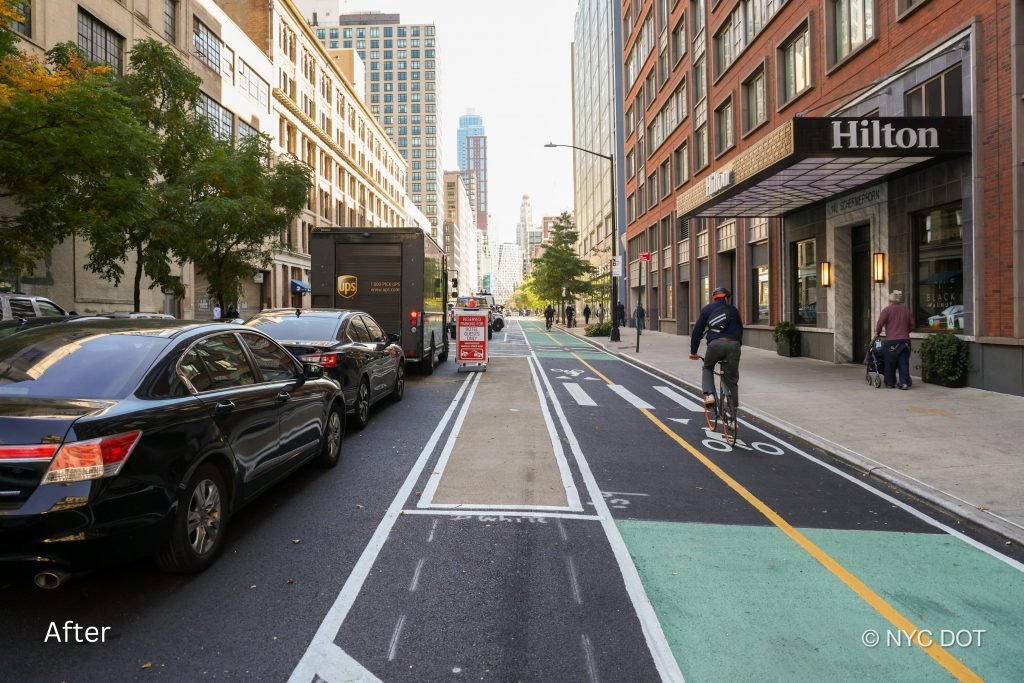
Looks fine right? Tons of space between cars and bikes. Problem solved! Wrong! Let’s look together at an actual photo from Richmond St. that I took. I’ve labeled the cars in green, bikes in blue, and pedestrians in yellow:
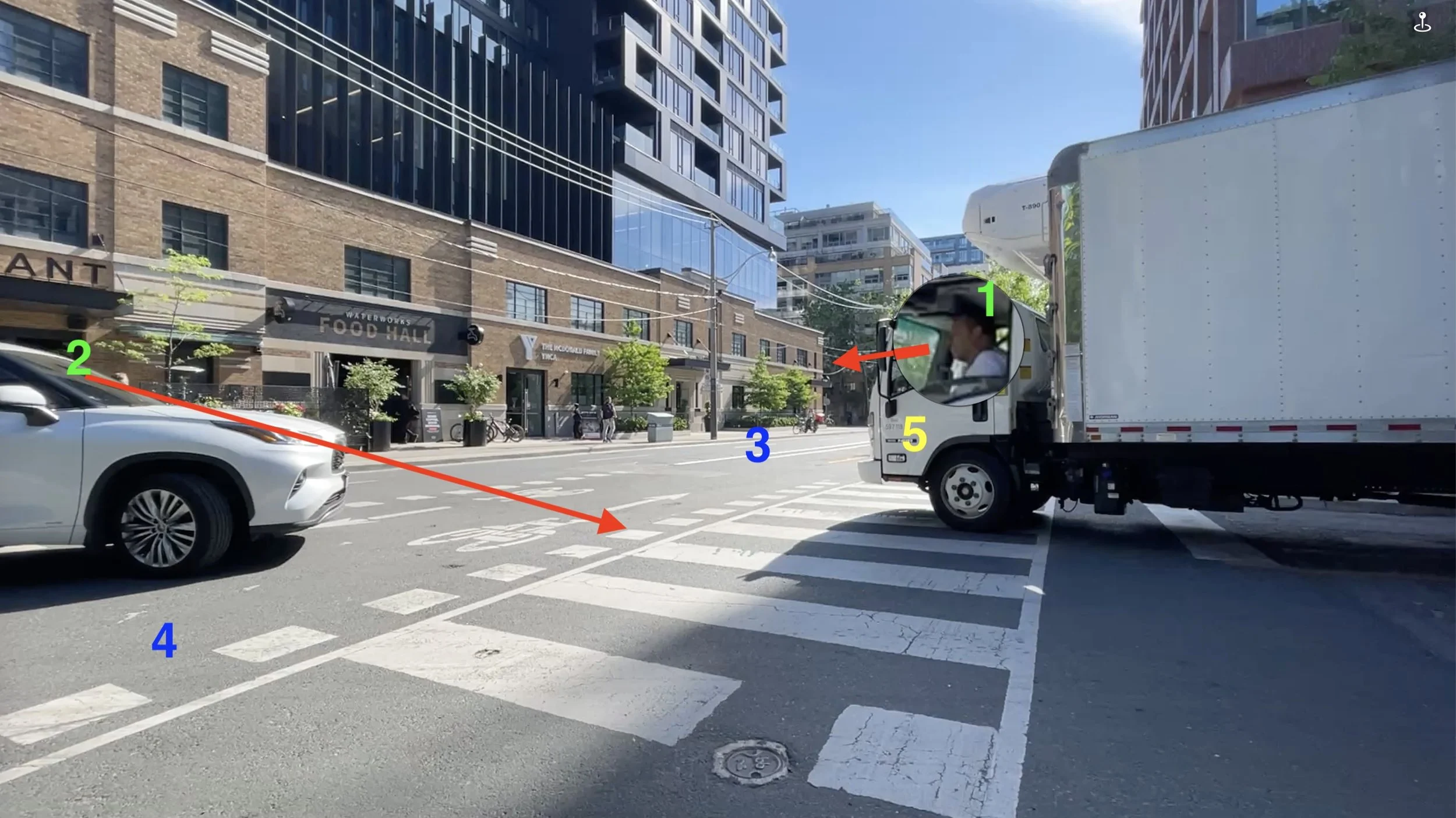
For anyone with a spatial mind, I’m sure you can see all the problems already, but I’ll go through each one for a safety perspective.
Truck 1
This truck is turning right, and as usually the case is that he has to creep well past the stop line to see oncoming cars such as the white one which are diagonally to his left and obscured by the corner around where the 4 is. This is due to the wide space from his stop line to the first car lane he’s turning into, which is made wider by the double bike lane. He is not only taking Pedestrian 5’s right of way, but if he goes any further in order to see, he’s encroaching the bike lane and potentially causing an accident. To compound the danger to Pedestrian 5 (unseen behind the truck), those pedestrians are fully in his blind spot.
Lastly, zoom in on his sightline which I’ve enlarged. He is clearly looking to the car traffic because that’s what drivers habitually do. He’s a car, he looks for cars. By nature of a busy oncoming traffic, he HAS to continually look left for a break in the cars so he can go. He cannot spend much or any time looking right in this design. This is almost certainly a pedestrian accident waiting to happen.
I’m repeating the photo above for mobile users so you can keep the image fresh in your mind while scrolling. Ironically, this is what drivers have to do when factoring in 5 conditions at once. How to keep the mental image present in mind and updated at all times… It’s impossible.
Secondly, look at Bike 3 (hypothetically) which is in the counter-traffic-flow-oncoming-bike-lane. Let’s say that the truck finds an opening after staring left for a few seconds or even a minute. Is he going to do his right check before going when he’s already encroached the pedestrian and bike lane? In watching about 100 vehicles for 15 minutes, only 1 driver I saw rechecked his right blind spot (if it could even be seen) before advancing into the bike lane. Remember it is not just a break in cars that the truck is waiting for, it is a break in bike traffic from the left, which is travelling at different speed to the cars. It’s already a very high cognitive load for any driver to cross 2 lanes of varying speed.
In short, Bike 3 is going to be directly in the oncoming truck’s path and the driver will not only have to monitor the bike and car lane to the left for a break but his eyes are supposed to also simultaneously be looking right for a break in the counter-traffic bike lane as well! Given the speed of cars and bikes, there is physically no way for a driver to eliminate the chance of one vehicle out of three being outside he vision.
In practice, drivers don’t wait, they go. In a busy traffic flow, waiting for these 3 conditions to be open at once does not occur. It is a design that breaks in high traffic. So both Pedestrian 5 and Bike 3 are at extremely high risk of being hit by a car while the truck is extremely irritated at waiting so long and having to monitor things out of both sides of his head simultaneously. Remember too there are a line of cars behind the truck honking wondering why is isn’t taking his right-turn right of way quickly… the pressure builds.
Car 2
Now let’s look at Car 2. I drew another arrow of this driver’s sightline which clearly shows that, up until turning the car about 45 degrees, Bike 4 is in his blindspot. This happens even on a 1-way bike lane, but because a 2-way bike lane is wider, it is much exacerbated. Basically Bike 4 has a much higher chance of being not seen, and conversely hit by any car in Car 2’s position. Compound the difficult of Car 2 seeing a pedestrian crossing simultaneously from the direction of Bike 4, forcing Car 2 to stop while obstructing 2 lanes of bike traffic and you can see that there is also a high chance of a cyclist hitting the side of Car 2. At rush hour there are frequently groups of 10 or 20 cyclists traveling at 20-30km/h, many with earbuds in and paying little attention.
Worse, does Car 2 even expect Bike 3 to be coming head on? Afterall, Car 2 as a driver is thinking “I'm on a one way street, I don’t need to look left while turning right. So Bike 3 could very likely also impact Car 2.
Ease of Use
From the very convoluted-ness of the above examples, I think it should be obvious that there is a very high cognitive load for all participants in this intersection which is never a good thing for ease of use. But, I want to turn to the bikes and pedestrians specifically since they are those who are supposed to be catered to in this counterproductive design.
Let’s imagine we’re Bike 4. You’re traveling along insulated from the one-way car traffic on your left. You feel safe for the stretches of bike lane where there are no intersections and then you come up on this intersection. You see Car 2 slowing and signalling to turn right taking your right of way. If you’re prescient, you ring your bell to announce you’re coming through. If you’re not, you expect your bike lane to protect you and the car will see you and you will cruise through. But then at the last moment you see Car 2 entering the lane. You have no bell or you react too late to stop. The protection of the bike lane has gone from 100% to 0% in a flash. A split second later you see the truck and if you successfully avoided Car 2 or made him stop through communicating with your bell, now you have a truck blocking your entire escape route. Imagine there are 10 cyclists traveling with you at high speed who all must make the same calculation at the same time to avoid running into you. Can you imagine the stress of biking in this bike lane? It’s exactly the opposite of what was intended.
How about Pedestrian 5? The truck is blocking your way but you have the right of way so you detour around the front to cross the street. Bam! Right into the oncoming bike lane which you cannot see because the truck is blocking your view. Do you wait the 1 minute or more that the truck is also being forced to wait because you can see that he cannot see you and will run you over if you go in front? Or do you walk to the back of the truck and look for a gap there because you know it will be safer, thus giving away your right of way and having to cross in the street?
Finally, in all this commotion, let’s imagine that one of the 5 people waves one of the other ahead in a kind gesture to solve one of their direct problems that I’ve gone through above. It sounds minimal in practice, but if even one person changes the rules in their situation, it creates havoc in all the others. The reason is because the mind is stupid. If you get a yes from one small factor, it overrides the others to also be a yes. For example, let’s say there’s a pedestrian crossing around where Bike 4 is and he good-naturedly waits and waves Car 2 through his right of way. What the hell does Car 2 do at that point? Does he absentmindedly go and cut off Bike 4 and 3? Who’s the hierarchical (not legal) boss of the intersection if the pedestrian hesitates or gives up his right of way? You can imagine any situation with any of the other 4 giving up or taking a right of way at an unsuspecting time for the others. At rush hour every single time I’ve been in this situation in this intersection, and similarly the other 2-ways nearby.
The problem with all of this is obviously the complexity of the two-way lanes. It’s not just adding “one more lane.” It’s more like trying to juggle 4 balls, or 5 compared to the normal 3 on a regular street. It’s exponentially harder for people to deal with. Practically, they add depth and width which creates horrible visibility angles. Finally, they create exponentially more complicated social hierarchies which do not follow the rules of the road or legal rules. Even if they, in places, technically follow the rules, there is no physical way to navigate them without breaking the law.
I’ll include one more photo I took here of this lane:
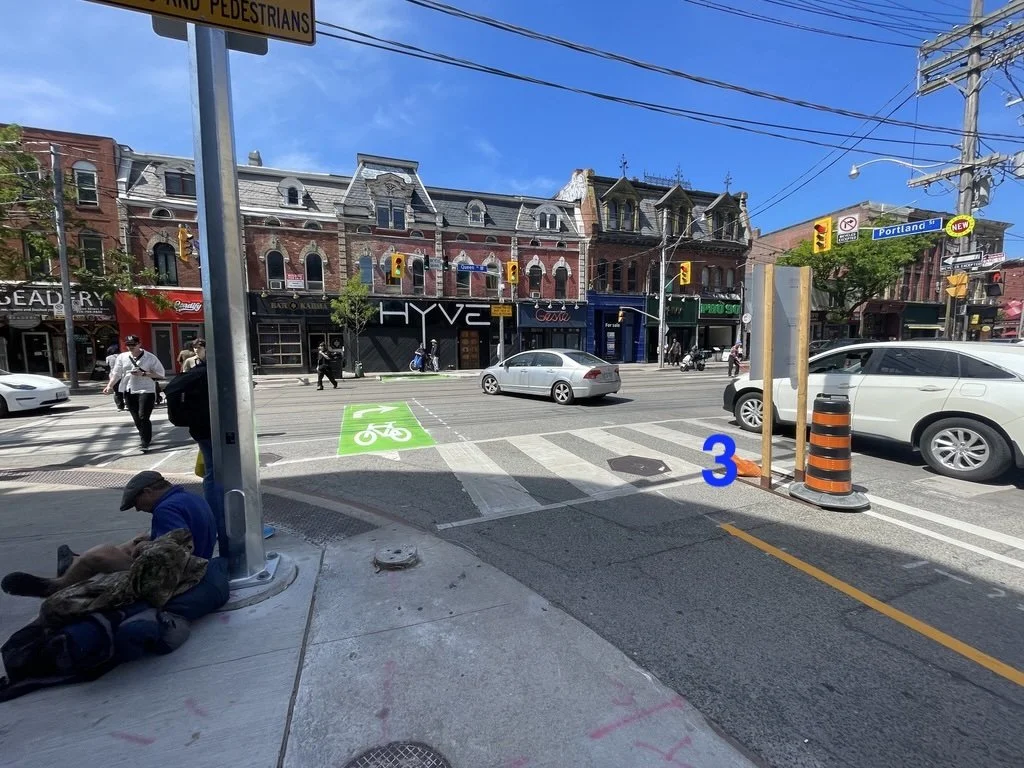
I want you to tell me how Bike 3 should turn right. Spoiler alert— it’s impossible to know. Do you go to that green box in oncoming traffic and be killed when the opposite traffic starts, or by an oncoming bike? Do you cut off the white SUV and be killed? Do you not advance in the green light and wait at the pedestrian crossing for a gap over your right shoulder to cross the car lane, while forcing bikers behind you to also stop because they don’t know what you’re doing? Do you dismount your bike and wait with pedestrians to cross the street and then remount and enter the lane? How do you even get out of the bike lane if there’s a green light?
It’s absolutely bonkers.
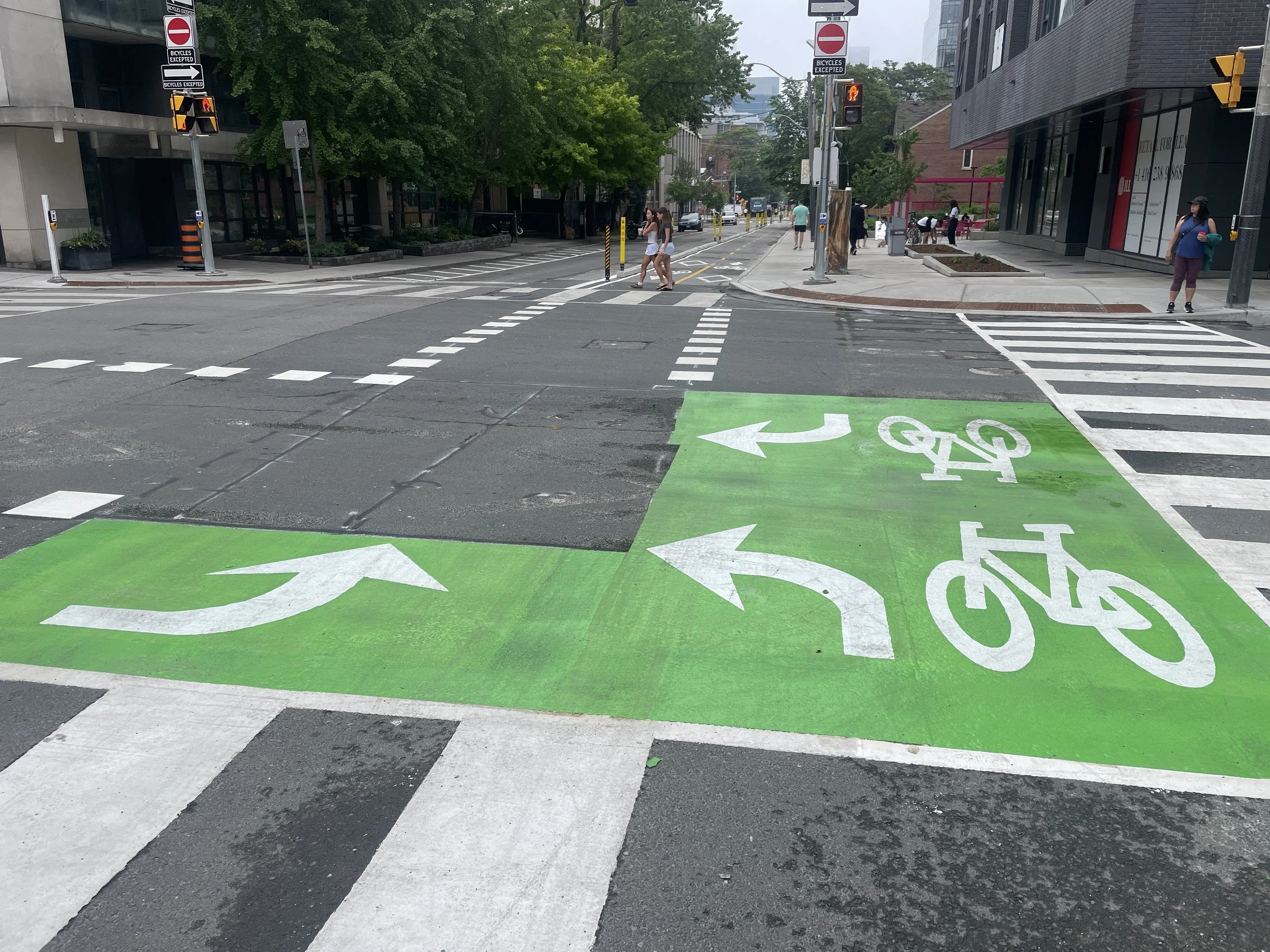
If you can’t figure out the rules of this intersection by staring at the photo, imagine trying while biking.
It’s clear that the people who designed these two-way bike lanes did not invest even the most basic modelling or real-world testing. With AI nowadays you could probably test this using Claude Code in 1-2 hours and simply watch the collisions. No, this is a solution that was certainly designed in abstract.
Space Usage
While it’s completely secondary to the grotesque dangers of the design, I want to point out one broader factor that I think is completely ignored in these designs. That is, it takes an existing road and it does nothing to reduce the congestion or improve the space usage. It simply adds extra bike lanes, in most cases duplicating nearby one-way bike lanes so that they can all be 2-way. The net result is there is no reduction in asphalt on a city level. And there is no increase in green or alternative space. There are tons and tons of stupid road designs as a result of 100 years of cars. Why the hell are we preserving that when thinking about non-car transport (I.e. bike lanes).
Here’s a radical idea— don’t just add two-way bike lanes to every street. Add one-way lanes and use that “bonus” bike lane for greenery or widening the sidewalk. This adds no extra depth that cars have to navigate through while adding greenery and space for pedestrians. This is the kind of atmosphere that truly improves cities.
One incidental point as well is that with all the extra bike-specific traffic lights, the flow of not only car traffic but bike traffic has slowed to a crawl. You have to stop at basically every major intersection due to the mismatch in speed of cars and bikes and the “need” to accommodate both. We’ve slowed down the specific mode of transport we are trying to encourage.
Finally, by converting streets from 2-way car streets to 1-way car streets, it generally does not reduce car congestion and certainly in the case of not even saving space or adding safety for bikers, all it does is anger car users. For the businesses on those streets, it is a poke in the eye. There are plenty of subtle street modifications used in Europe and Japan that solve all these problems at once.
Instead, what these two-way bike lanes and complex traffic light systems and convoluted compensatory Windows 95 style explanatory signage are doing is making people extremely confused, stressed and angry. I’ve seen it daily. Cyclists, pedestrians and drivers each are yelling, honking, and aggressively driving to a degree that is 3x worse than before.
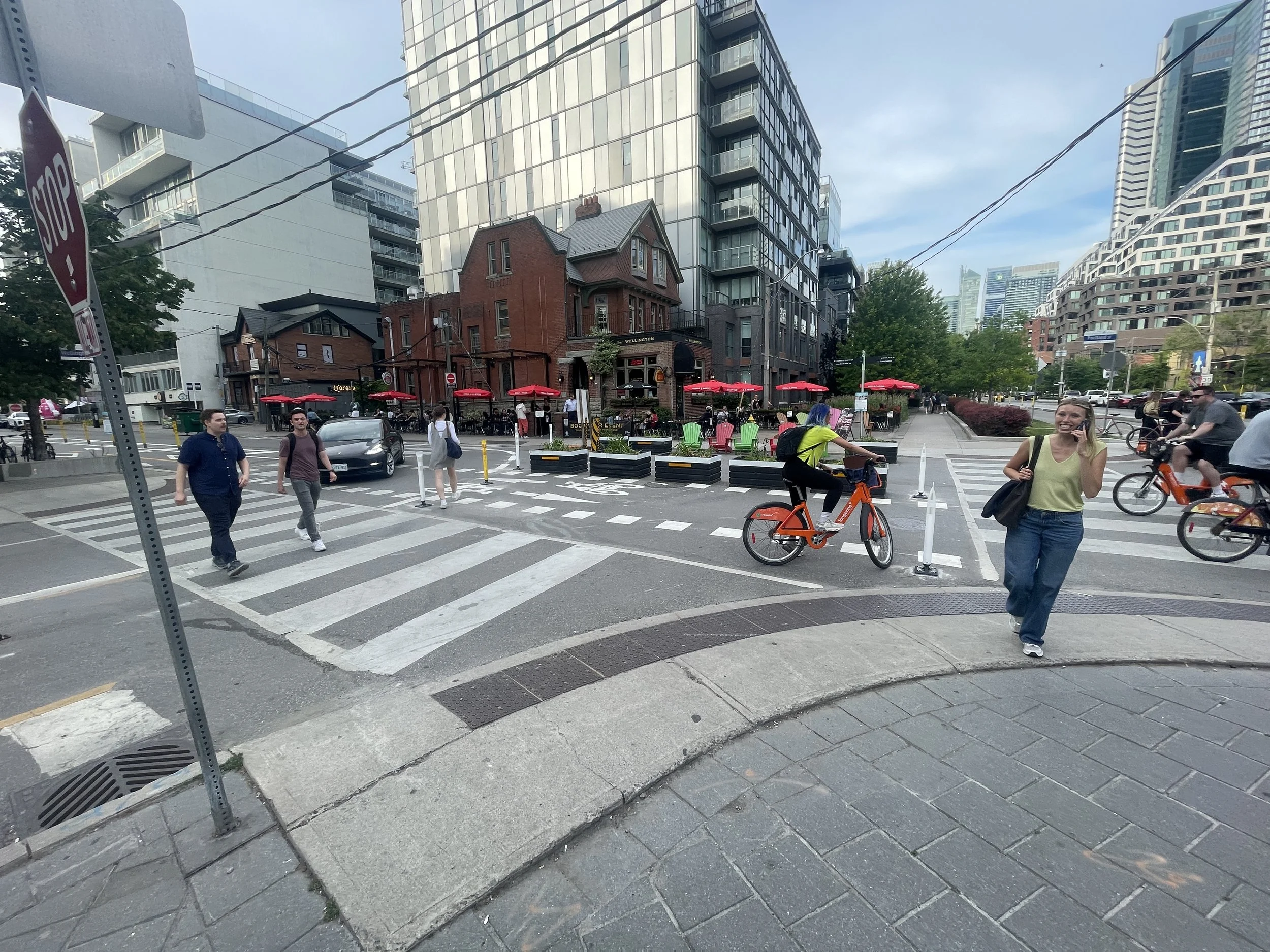
I dare you to try to cross this intersection at 6pm on a Friday night
CONCLUSION
I’m a fan of bike lanes that run parallel to the traffic flow with minimal separation from cars. Painted areas are the best because it preserves all the existing rules of the road for everyone and encourages bikes to follow them as much as cars. It also mentally keeps cyclists alert versus lulling them into 100% safety and then suddenly entirely reintroducing immense danger.
If car lanes are removed for these single lane bike lanes, the extra space should be used to make more green and wider sidewalks. The flow is maintained, the angles of visibility are maintained, and the rules of the road that generations are raised on are maintained.
However, this downtown two-way redesign is a complete disaster. It is utterly unsalvageable and should be ripped out as soon as possible. Primarily this is because of the danger it creates, but secondarily, we have rules of the road that are universal. If you force people to break them to navigate these intersections, you are training them to avoid all the rules. The e-bike delivery drivers already learned to do this and they are a menace in every direction. After a few months of driving on these roads everyone— cars, bikes and pedestrians all— will learn that if they want to go where they’re going they have to make up their own rules. This is not the type of attitude you want to be installing with your physical city design.
PRICE
Sanity
AVAILABILITY
On the street
THE RATING
0/10 Absolute
0/10 Relative
Your donation helps keep the reviews coming!